
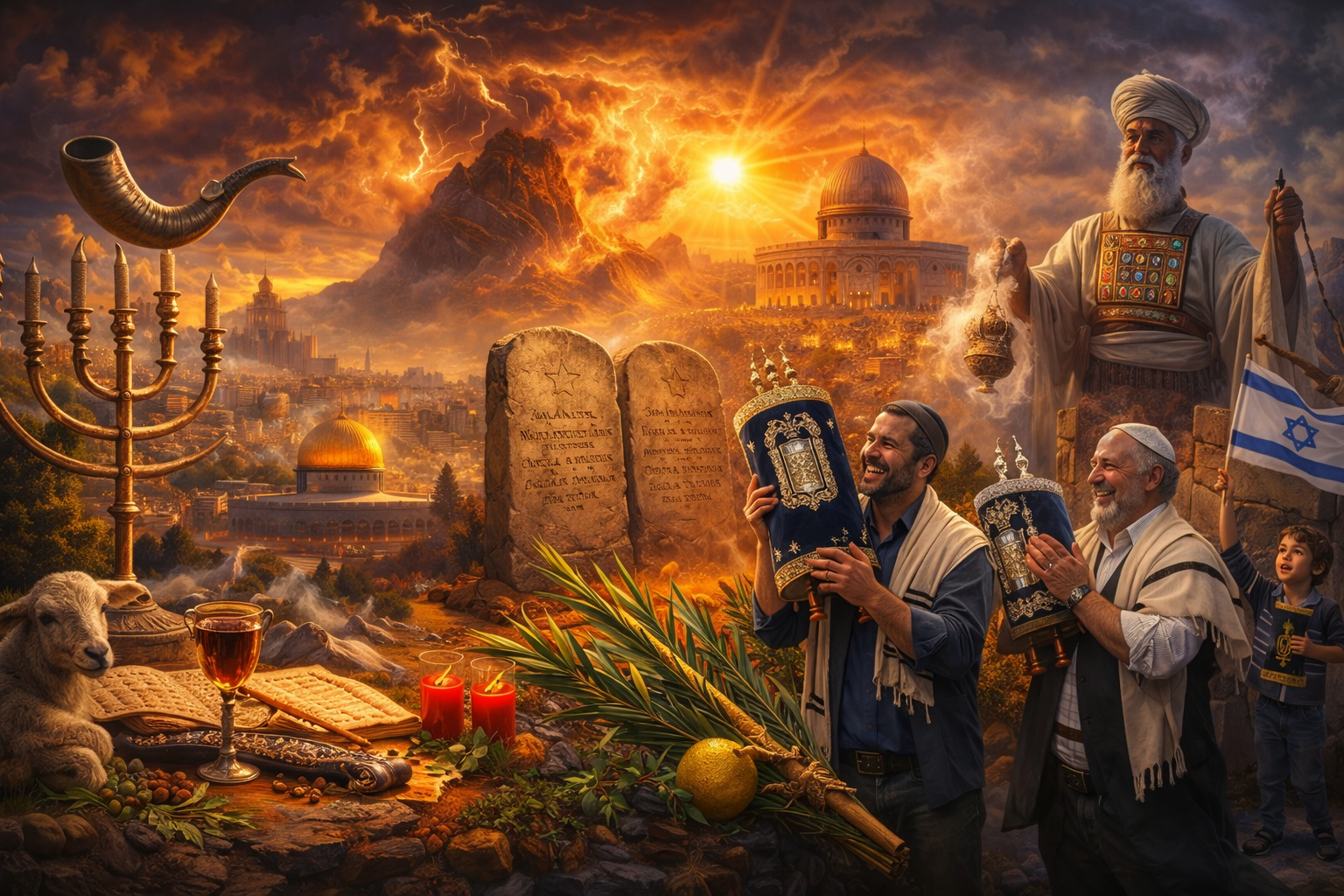
God's Festivals: Annual Rehearsals
From the beginning of creation, God instituted the daily, weekly, monthly, and yearly cycles that separate the seasons of the earth (Genesis 1:14–16). The movement of the moon around the earth and the earth around the sun marks time with precision—revealing a Divine blueprint in both nature and prophecy.
The cycle of time that divides spring, summer, autumn, and winter also unites the seasons in a beautifully orchestrated production of God’s creative marvel. From spring’s budding life and summer’s blooms, to fall’s colors and winter’s blanket, these repeating periods build stability into the human experience.
The Maker has united earth and sea with organisms in a balanced cycle of life—so that the unseen God can be clearly witnessed in nature’s evidence, leaving us without excuse for ignoring Him (Romans 1:20). Added to this, the same Designer has fashioned spiritual and prophetic mysteries tied to God’s annual appointed times (Leviticus 23), revealing wisdom that surpasses human intellect—even foretelling future events in the annual rehearsals throughout history.
Egyptian Slaves Free To Rest
When the Holy One of Israel delivered the Israelites from Egyptian slavery at the Exodus nearly 3,500 years ago, God led them to Mount Sinai. There the Messenger of the Covenant (Angel of the Lord—Acts 7:30–38; Deuteronomy 33:2) revealed the Everlasting Covenant promised to Abraham and his descendants (Genesis 17:7). Deuteronomy 4:13 says, “He declared to you His Covenant, the Ten Commandments… and wrote them on two stone tablets.”
Leviticus 23 begins by reminding God’s people of the seventh-day Sabbath—given at creation as a day of rest (Genesis 2:2–3). Jesus Himself created all things (John 1:1–3; Hebrews 1:2; Colossians 1:15–16), and during His earthly ministry claimed rightful Lordship over the Sabbath (Mark 2:27–28). Having been freed from relentless bondage, Israel was again offered a gift: rest, worship, and renewal.
The seven-day week does not correlate neatly to lunar motion or a 30-day month. Yet God saw mankind’s need for rest and provided the seventh day as a gift. “There remains… a Sabbath-rest for the people of God” (Hebrews 4:9–10).
The Appointed Feasts of the Lord
Before printed calendars, the world marked time by the earth and moon in relation to the sun. The first sliver of the new moon heralded a new month. Scripture teaches that each day begins at evening (Genesis 1:5), and many observers still keep Sabbaths and holy days from “evening… until the following evening” (Leviticus 23:32).
Spring Appointments
Leviticus 23:4–22 introduces God’s annual holy days—“appointed feasts… sacred assemblies… at their appointed times.” God designed His religious year to begin in spring with Passover (Pesah): the seder prepared before sunset on the fourteenth day of the first month. As the sun sets, the fifteenth day begins and the Feast of Unleavened Bread is observed without leaven. During this week, Firstfruits is honored— the first grains of harvest offered in thanksgiving. From this begins the count of seven weeks (49 days), leading to Pentecost (Shavuot) on day fifty.
Fall Appointments
After the summer months, the fall observances arrive (Leviticus 23:23–44). The Feast of Trumpets (Rosh HaShanah) is on the first day of the seventh month. Ten Days of Repentance lead to the Day of Atonement (Yom Kippur)—the most solemn day of the calendar, portrayed as Heaven’s “gates closing” and the cutting off of the unrepentant. Five days later comes Tabernacles (Sukkot), an eight-day celebration that teaches this world is a temporary dwelling on the way to the ultimate wedding, the New Jerusalem, and God’s eternal kingdom.
Fasts of Mourning
In addition to the feasts, Zechariah 8:19 speaks of four fasts of mourning tied to tragedies in Israel’s history. Of particular solemnity is the Three Weeks—from the 17th of Tammuz to the 9th of Av—ending in Tisha Be-Av, associated with the destruction of both Temples (586 B.C. and A.D. 70).
Why Should Gentiles Care?
Jew and Gentile alike can gain insight into God’s final plan by understanding His Festivals and their connection to the last days. Prophecy was delivered through Hebrew prophets, and end-time understanding is best built upon that foundation. Misreadings multiply when plain prophecies are “spiritualized” away from their Hebrew intent.
Scripture also rejects the idea that God has discarded Israel and replaced her. Paul wrote plainly: “Did God reject His people? By no means!” (Romans 11:1–2). He explains a partial hardening “until the full number of the Gentiles has come in,” and “so all Israel will be saved” (Romans 11:25–26).
A Shadow Of Things To Come
The Festivals are presented as a shadow of end-time realities—type meeting antitype at the appointed time. Scripture repeatedly ties “appointed time” language to the end (Daniel 8:19; Daniel 11:27; Daniel 11:35; Habakkuk 2:3). Jesus Himself fulfilled key festival markers in His earthly ministry, and prophecy points to complete fulfillment in the last days.
Acts 1:6–7 connects Israel’s restoration question to “appointed times and seasons.” Paul likewise links “times and seasons” to the Day of the Lord and urges believers to remain alert (1 Thessalonians 5:1–6).
Explore the Festival Pages
Use the links below to read the festival pages already created. You can also return to the main Festival page at any time.
The Biblical Calendar
| Order | Jewish Month Name | Corresponding Months |
|---|---|---|
| 1 | Nisan (Abib) | March–April |
| 2 | Zif (Iyar) | April–May |
| 3 | Sivan | May–June |
| 4 | Tammuz | June–July |
| 5 | Ab (Av) | July–August |
| 6 | Elul | August–September |
| 7 | Tishri | September–October |
| 8 | Bul | October–November |
| 9 | Chisleu | November–December |
| 10 | Tebeth | December–January |
| 11 | Sebat | January–February |
| 12 | Adar | February–March |
| — | Ve-Adar (Leap Month) | Intercalary month (leap years) |
Unlike many modern national holidays, God’s festival observances move across the Gregorian calendar, sometimes varying by weeks from year to year. This movement reflects the integrated lunar/solar nature of the Jewish calendar, including the periodic addition of a leap month to keep appointed times in their correct seasons.
To demonstrate the movement of dates year to year, you referenced adding a schedule link on the page. If you have that destination page ready,
you can place it below as a simple link (example):
About the Author, Kevin Swift