The Iran War & Bible Prophecy
Are We Witnessing the Fulfillment?
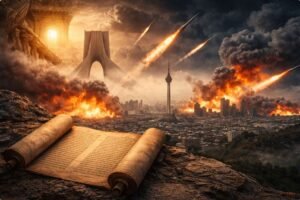
A Message About Elam
34 This is the word of the Lord that came to Jeremiah the prophet concerning Elam, early in the reign of Zedekiah king of Judah:
35 This is what the Lord Almighty says:
“See, I will break the bow of Elam,
the mainstay of their might.
36 I will bring against Elam the four winds
from the four quarters of heaven;
I will scatter them to the four winds,
and there will not be a nation
where Elam’s exiles do not go.
37 I will shatter Elam before their foes,
before those who want to kill them;
I will bring disaster on them,
even my fierce anger,”
declares the Lord.
“I will pursue them with the sword
until I have made an end of them.
38 I will set my throne in Elam
and destroy her king and officials,”
declares the Lord.
39 “Yet I will restore the fortunes of Elam
in days to come,”
declares the Lord.
A Message About Elam (Jeremiah 49:34-39) – Comments Tied to Recent Decades and the 2026 War with Iran
Elam in the Bible refers to an ancient region in what is now southwestern Iran (primarily Khuzestan province, with Susa as its historic capital). Many students of Bible prophecy view this oracle—delivered early in Zedekiah’s reign (around 597–586 BC)—as having layers: a near-term historical judgment (fulfilled in part by Babylonian and later Persian actions) but also a far-future application to modern Iran, especially amid regime pressures, military conflicts, and mass displacements.
The passage describes divine judgment on Elam’s power followed by unexpected restoration. Here’s a verse-by-verse look, connecting it to events over the last few decades and the ongoing U.S.-Israel war against Iran that erupted on February 28, 2026 (now in its sixth week as of early April).
Verse 35: “See, I will break the bow of Elam, the mainstay of their might.”
The “bow” symbolizes Elam’s core military strength—historically their famed archers. In modern terms, prophecy watchers often link this to Iran’s launchers; particularly, their missile and drone programs, ballistic capabilities, nuclear infrastructure ambitions, and proxy network (Hezbollah, Houthis, etc.), which have been the regime’s primary offensive tools since the 1979 Islamic Revolution.
Over the decades, Iran built this up through the Iran-Iraq War (1980–1988), sanctions evasion, and asymmetric warfare. In the current conflict, U.S. and Israeli strikes have repeatedly targeted missile sites, air defenses, petrochemical facilities (producing half of Iran’s output in some cases), and energy infrastructure—directly “breaking” the regime’s ability to project power and sustain its war machine. Reports of precision hits on IRGC assets and strategic sites align with this imagery of a once-formidable “mainstay” being systematically dismantled.
Verse 36: “I will bring against Elam the four winds from the four quarters of heaven; I will scatter them to the four winds, and there will not be a nation where Elam’s exiles do not go.”
This speaks of total dispersion—no corner of the earth untouched by Iranian refugees or exiles. The 1979 Revolution triggered the first massive wave: millions fled the new Islamic Republic, forming today’s global Iranian diaspora (estimated in the millions across North America, Europe, Australia, and beyond). The Iran-Iraq War added further displacement and casualties in the hundreds of thousands. Sanctions, protests (2009 Green Movement, 2022 Woman-Life-Freedom uprising), and proxy entanglements kept the outflow steady. Now, in the 2026 war, the UN estimates 3.2 million Iranians displaced internally since late February, with fears of a broader refugee crisis spilling into Turkey, Europe, and neighboring states if strikes intensify or the Strait of Hormuz remains contested. Diaspora communities are already fractured—some calling for intervention, others opposing foreign strikes—mirroring the “four winds” scattering.
Verse 37: “I will shatter Elam before their foes, before those who want to kill them; I will bring disaster on them, even my fierce anger,” declares the Lord. “I will pursue them with the sword until I have made an end of them.”
“Foes” and “sword” point to military defeat and relentless pursuit. Iran has faced enemies for decades: the 1980s war with Iraq (Saddam as the initial foe), U.S. sanctions post-1979 hostage crisis, Israeli shadow operations (assassinations of nuclear scientists and Soleimani in 2020), and proxy battles in Syria, Yemen, and Lebanon. The 2024–2025 escalations (embassy strike in Damascus, brief 12-day war) set the stage.
In the current war, Israeli and U.S. airstrikes have hit civilian-adjacent infrastructure, hospitals, universities, and command centers, with confirmed deaths of IRGC intelligence leaders and other officials. Iranian missile counterstrikes (including cluster munitions on Israeli cities) have caused damage but haven’t halted the pursuit. The language of “disaster” and “fierce anger” resonates with the scale of bombardment—energy sites crippled, leadership decapitated, and the regime’s “sword” (its retaliatory capacity) blunted amid ongoing ultimatums.
Verse 38: “I will set my throne in Elam and destroy her king and officials,” declares the Lord.
God asserts sovereign judgment by “setting His throne” there—meaning direct divine intervention in the seat of power. Historically, this echoed Babylonian conquest; today, many see it in the targeting of the Islamic Republic’s top echelons. The Supreme Leader’s inner circle, IRGC commanders, and officials have faced assassinations and strikes (e.g., recent IRGC intelligence chief killed). Prophecy commentators are openly discussing this as potential regime-ending pressure, with the “king and officials” imagery applied to the theocratic leadership structure that has ruled since 1979. The war’s focus on decapitating command networks fits the pattern.
Verse 39: “Yet I will restore the fortunes of Elam in days to come,” declares the Lord.
This is the hopeful pivot—judgment is not the end. After scattering and shattering comes restoration. Despite decades of exile, war, and repression, a remnant returns. In current discussions, this points to the Iranian people (not necessarily the regime) experiencing future blessing—possibly through gospel revival (Iran has seen one of the fastest underground church growth rates in the world), post-conflict rebuilding, or exiles returning home. Even amid the 2026 displacements, voices in the diaspora express longing for a free Iran where “fortunes” are restored. The “days to come” (latter days language) leaves room for long-term hope beyond the present conflict.
In summary, this passage is frequently cited right now in prophecy circles as strikingly relevant: Iran’s military “bow” under sustained attack, leaders pursued and removed, millions scattered anew, yet a promised future restoration for the people. The 1979–2025 buildup (revolution, wars, sanctions, proxies) created the conditions; the February 2026 outbreak has accelerated the “shattering.”
Of course, biblical prophecy can have multiple layers and timings—some see full fulfillment still ahead or partial echoes—but the parallels are hard to ignore for those watching current events through Scripture. The text balances sobering judgment with ultimate mercy, a reminder that God’s purposes extend beyond any single conflict.